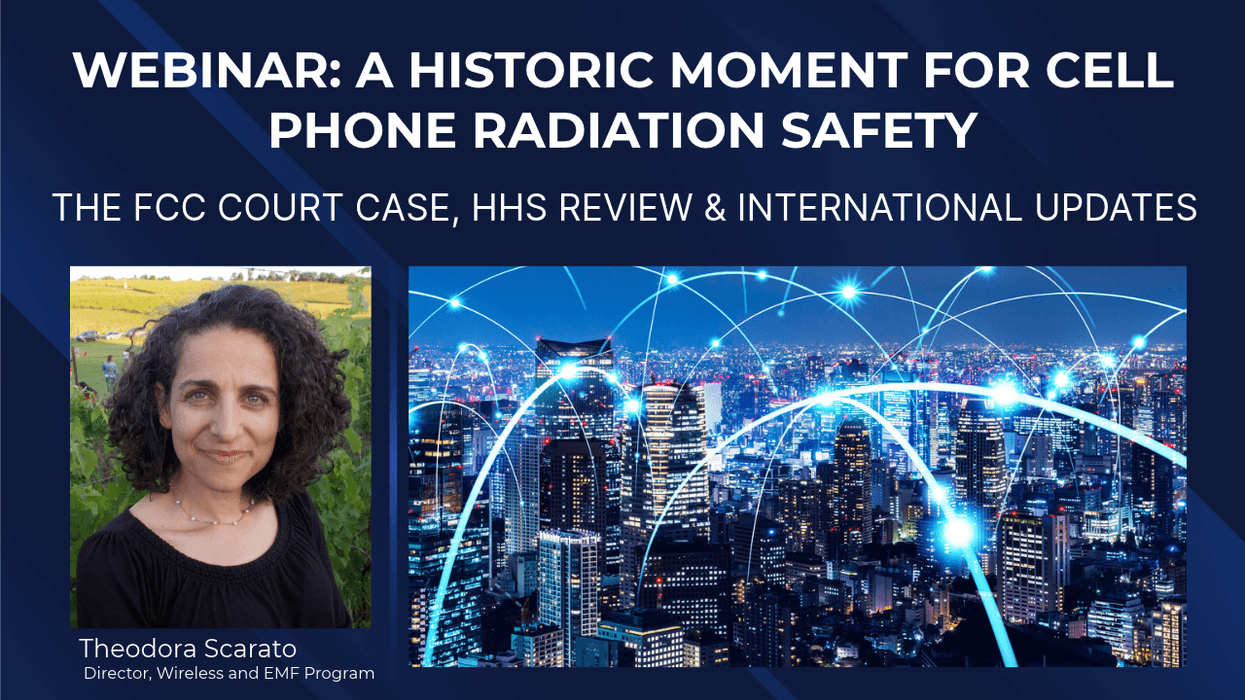
Webinar: A Historic Moment for Cell Phone Radiation Safety
The FCC Court Case, HHS Review and International Updates
Date: Wednesday, October 7th, 2026
Time: 12 pm ET / 9 am PT
This is a historic moment in the U.S and internationally. In this webinar, Theodora Scarato, policy expert and Director of the Wireless and EMF Program at Environmental Health Sciences, will present on the latest developments:
U.S Federal Agencies Are Requesting Public Comment:
For the first time, the U.S. Federal Communication Commission (FCC) has been forced to explain why it has not complied with a landmark 2021 federal court ruling on cell phone, cell tower, and wireless network radiation safety. Nearly five years ago, the DC Circuit ordered the FCC to explain why its exposure limits have remained unchanged since 1996. The FCC was mandated to explain how it made its decision to retain 1996 limits in regards to record evidence on children’s vulnerability, the risks of long-term exposure, environmental impacts, and how the decades-old 1996 limits are relevant to today’s now ubiquitous wireless technologies. Scarato will review the FCC’s latest response to the Court.
Now, two U.S. government agencies, the FCC and Health and Human Services (HHS), are calling for public comment on wireless health effects, with comments due in a few weeks.
International Developments:
The European Commission is adopting a tighter cell phone radiation testing standard to require phones be tested at body contact.
Further, Italy’s Supreme Court issued a landmark ruling in a case against Apple holding that compliance with technical standards does not, by itself, relieve a manufacturer of its duties to consumers- that companies must also clearly inform users how the phone should be used to remain within those limits and adequately inform consumers about potential health risks and precautions, so they can make informed decisions about how they use the device.
In Germany, plaintiffs have filed suit against the federal government seeking a reassessment of wireless radiation limits arguing that current standards are not protective.
About Theodora Scarato:
Theodora Scarato is the Director of the Wireless and EMF Program at Environmental Health Sciences (EHS) and a nationally recognized expert in environmental health policy related to cell towers, wireless radiation, power lines and electromagnetic fields (EMF).
Scarato’s work was pivotal in the 2021 FCC wireless guidelines case and she is a petitioner in the original case. She has co-authored several science and policy papers on EMF, health, and environment including a publication “U.S. policy on wireless technologies and public health protection: regulatory gaps and proposed reforms” focused on the gaps and deficiencies in the US regulator framework for wireless radiation. She also serves as a Special Expert to the International Commission on the Biological Effects of Electromagnetic Fields (ICBE-EMF). Full BIO