
A new study published in Environmental Research by Thielens et al. measured environmental levels of radiofrequency radiation (RF) - the electromagnetic radiation emitted by cell towers, 4G/5G and other wireless networks - across all five boroughs of New York City and found levels over 100 times higher than those previously reported by the EPA in 1976.
In short:
- Manhattan had the highest RF levels of all five boroughs (over four times higher than the lowest mean value measured in Staten Island), as did commercial areas when compared to residential, greenery, and underground subway areas in the city.
- The wireless RF signals sent from cell towers, small cells, and other 4G/5G infrastructure, known as cellular downlink, contributed most to outdoor environmental exposures (45% - 55%) compared to the other 5 categories of technology, which included radio/TV, and Wi-Fi.
- Cellular downlink also remained the dominant source of exposure indoors, with Wi-Fi representing the second-largest contributor.
- Areas with heavier pedestrian foot traffic were also associated with higher RF exposure levels.
Key quote:
“The study provides… a clearer understanding of the extent of exposure in a densely populated city like New York where wireless communication networks are continuously expanding. These results are important for policymakers when establishing RF exposure guidelines for the population of NYC and other urban areas in North America.”
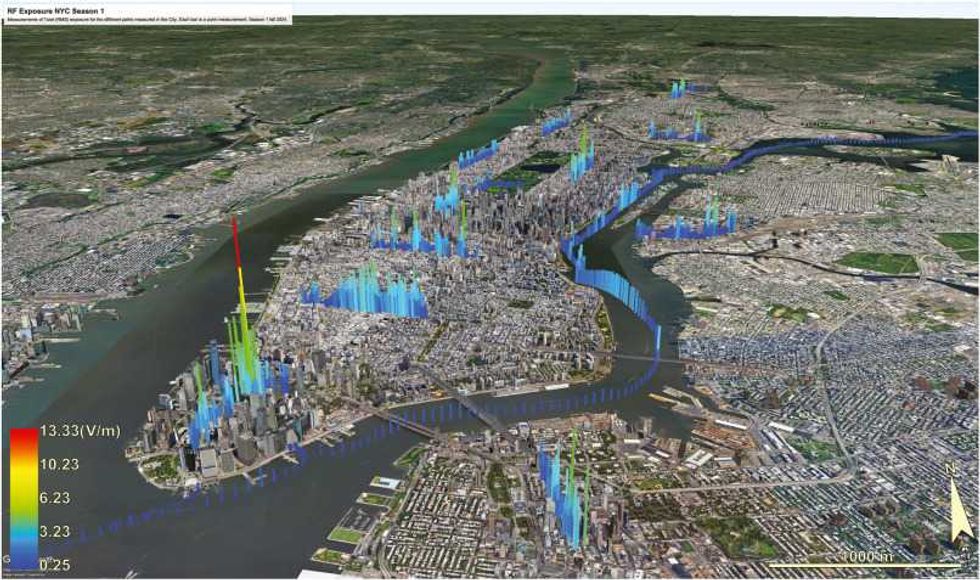 Fig. 3 from Theilens et al. 2026 qualitatively illustrates the spatial variability of the RMS E-Field strength in a 3D perspective image of the boroughs of NYC (Staten Island not shown). It shows that the highest single-point total exposure was measured in downtown Manhattan, in the financial district. Theilens, A. et al. (2026). Urban Radio-Frequency Electromagnetic Field Exposure in New York City. Environmental Research
Why this matters:
Communities throughout New York City have been opposing the jumbo 5G towers across the city for years, citing numerous concerns, including health effects. Now, the FCC is proposing to fast-track cell towers nationally by pre-empting local city and state control, a move that the International Commission on the Biological Effects of Electromagnetic Fields states “could come at a serious cost to public health and the environment.”
A substantial body of research has linked exposure to cell tower RF radiation to health impacts, from cancer to altered immune system activity, chromosomal changes and wildlife impacts.
As early as 1985, the New York City Department of Health Bureau for Radiation Control stated RF radiation was “new to humankind” and proposed an RF limit at a level hundreds of times below the levels that later informed U.S. limits. However, the EPA was ultimately defunded from its research on developing safety standards and the FCC instead adopted industry limits that have been unchanged and without scientific review since 1996. The EPA's national measuring program was also terminated, and today, cell towers are subject to minimal regulatory oversight without any monitoring of the rising environmental exposures.
Although the latest New York City study reported levels were well below FCC and ICNIRP limits, scientists have long cautioned that compliance with these limits does not ensure safety, as they were designed only to address the overheating effects of short term exposure. A recent analysis concluded that these limits are at least 200 times too high to be protective against cancer risk, based on data from the National Toxicology Program cell phone radiation study.
"This study shows how people are continuously exposed to cell tower radiation, even if they are not using a cell phone. The public has a right to know the levels of their involuntary everyday exposures," said Theodora Scarato, director of the Wireless and EMF program at EHS. "The EPA used to measure cell tower radiation levels, research health effects, and even worked to develop safety standards, but the programs were defunded decades ago.” She highlighted how countries like France, Switzerland, and Greece have websites that allow residents to easily see wireless radiation exposure measurements in their area. Scarato has filed numerous public information requests to New York City requesting the RF measurements for their 4G and 5G antennas, but the City has only responded with extensions. “The need for more transparency regarding our everyday RF exposure is urgent.”
Policy changes at every level of government are needed, including the implementation of a measuring and monitoring program, premarket safety testing for all new wireless technologies, and policies to reduce exposure and mitigate risk, especially near homes and schools.
Related EHN coverage:
- Majority of studies report human health impacts from cell tower radiation exposure
- Study: Wireless radiation limits are at least 200x too high to protect against cancer risk
- U.S. cell tower & cell phone radiation policy fails public health, new paper finds
More resources:
- Fact Sheet: Scientific Research on Cell Towers
- Fact Sheet: 5 Invisible Sources of Wireless RF Radiation at Home
- Fact Sheet: Cell Tower Radiation Limits U.S. & Worldwide
- Parent Toolkit on Cell Towers at Schools